


 русский
 Español
 عربى
عربى

Content
How Each Pump Works: Operating Principles
Both vane pumps and gear pumps are positive displacement pumps — meaning they move a fixed volume of fluid per revolution regardless of outlet pressure. Despite this shared characteristic, their internal mechanisms are fundamentally different, and those differences drive every performance trade-off discussed in this article.
Vane Pump Operating Principle
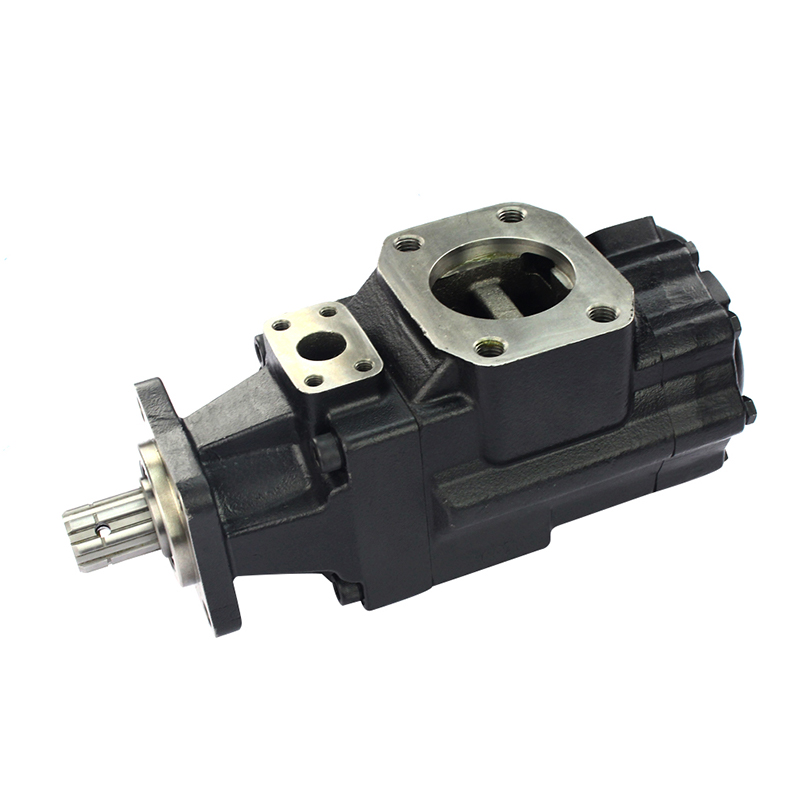
A vane pump consists of a rotor mounted slightly off-center inside a circular cam ring. The rotor carries a series of flat rectangular vanes that sit in radial slots. As the rotor spins, centrifugal force — assisted in many designs by spring-loaded pushrods or fluid pressure behind the vanes — keeps each vane pressed firmly against the inner surface of the cam ring. This creates a series of sealed chambers between adjacent vanes. As the rotor turns, these chambers expand near the inlet, drawing fluid in, then contract near the outlet, forcing fluid out. The gradual, continuous nature of this compression cycle is what gives vane pumps their characteristically smooth, low-pulsation flow.
A key design advantage is self-compensation for wear: as the vane tips erode over time, they continue to extend outward to maintain contact with the cam ring, preserving the seal and sustaining volumetric efficiency. When wear eventually exceeds the self-adjustment range, the vanes can be replaced individually at low cost without replacing the entire pump body.
Gear Pump Operating Principle
Gear pumps operate by meshing two or more gears inside a tightly fitted housing. In an external gear pump — the most common configuration — two gears of identical size rotate in opposite directions. As the teeth disengage near the inlet, they create a low-pressure zone that draws fluid into the pump. The fluid is then carried in the spaces between the gear teeth and the housing wall around the outer path to the outlet, where the teeth re-engage and force the fluid out under pressure. Internal gear pumps follow the same principle but use a small inner gear rotating inside a larger outer gear, with a crescent-shaped divider separating the inlet and outlet chambers.
Because the gear teeth mesh at a single point on each revolution, gear pumps produce a slight periodic pressure pulse with each tooth engagement. This pulsation is generally acceptable in rugged industrial environments but can be problematic in precision applications. The primary structural advantage of gear pumps is simplicity: an external gear pump contains as few as four major components — two gears and two shafts — making it among the most straightforward hydraulic pumps to service.
Performance Comparison: Pressure, Flow, and Efficiency
Pressure Range
Gear pumps generally support higher maximum operating pressures than vane pumps. External gear pumps can reach pressures of up to 250 bar (3,600 psi) in standard industrial models, with some heavy-duty designs exceeding this. Vane pumps typically operate in the range of 70 to 175 bar (1,000 to 2,500 psi) for fixed-displacement models, though certain high-pressure vane designs can approach 200 bar (2,900 psi). For systems requiring pressures above this threshold, gear pumps or piston pumps are the more appropriate choice.
Flow Consistency
Vane pumps produce significantly smoother flow than gear pumps. The continuous engagement of vanes against the cam ring creates minimal pulsation, which is critical in applications such as CNC machining, injection molding, and servo-hydraulic systems where pressure fluctuation translates directly into dimensional variation in the finished product. Gear pumps produce a measurable flow ripple with each tooth engagement; in most industrial and mobile hydraulic applications this is inconsequential, but it disqualifies gear pumps from precision fluid metering tasks.
Volumetric Efficiency
Vane pumps achieve higher volumetric efficiency at partial loads, primarily because the self-sealing vane design limits internal leakage across a wide range of operating conditions. Gear pumps maintain good efficiency at full load and rated pressure, but their efficiency drops more steeply as internal clearances increase through wear — a process sometimes called slippage — because there is no self-compensating mechanism equivalent to the extending vanes. Variable-displacement vane pumps offer a further efficiency advantage: they can match output precisely to system demand, eliminating the energy wasted by a fixed-displacement pump recirculating excess flow through a relief valve.
Fluid Compatibility and Viscosity Handling
Viscosity is one of the most decisive factors in pump selection, and the two pump types perform very differently across the viscosity spectrum.
High-Viscosity Fluids
Gear pumps — particularly internal gear designs — excel with thick, viscous fluids such as heavy oils, bitumen, molasses, adhesives, and high-viscosity polymers. The gear teeth scoop and carry dense fluids effectively at slow rotational speeds, and the pump can build adequate inlet suction even when the fluid resists flowing into the pump under its own weight. Vane pumps can handle moderately viscous fluids, but thick media cannot fill the vane chambers quickly enough at normal operating speeds, requiring significant speed reduction to prevent cavitation. This limits their practical upper viscosity range to approximately 500–800 cSt under most operating conditions.
Low-Viscosity and Thin Fluids
Vane pumps outperform gear pumps when handling thin, low-viscosity fluids such as gasoline, solvents, light fuel oils, and alcohols. The open chamber geometry and strong centrifugal vane extension enable fast, efficient suction even at extended inlet distances — an important advantage in tank truck loading, fuel transfer, and similar bulk liquid handling applications. Gear pumps can handle low-viscosity fluids, but thin fluids provide less internal lubrication for the gear teeth and bushings, accelerating wear unless the pump is specifically designed and rated for such service.
Fluid Cleanliness Requirements
Both pump types require clean fluid, but vane pumps are more sensitive to contamination. Abrasive particles in the fluid accelerate vane tip wear and can score the cam ring surface. Gear pumps tolerate moderately contaminated fluids better due to their robust metal-to-metal construction, though sustained contamination will still cause premature failure. Neither type should be used with fluids containing solid particles without upstream filtration. As a general guideline, vane pump systems benefit from finer filtration — typically 10 microns or better — compared to the 25-micron filtration commonly adequate for gear pump circuits.
Noise, Vibration, and Maintenance
Noise and Vibration
Vane pumps are among the quietest positive displacement pumps available, with typical operating noise levels as low as 60 dBA under normal conditions. The smooth, continuous vane action generates minimal flow pulsation and correspondingly low structural vibration — a significant advantage in indoor manufacturing environments, medical equipment, and any application where operator comfort or acoustic regulations apply. Gear pumps produce more noise and vibration due to the periodic impact of gear teeth meshing under load. In outdoor, mobile, or industrial settings this is rarely a concern, but it makes gear pumps a poor fit for noise-sensitive environments.
Maintenance Requirements
Gear pumps hold a clear advantage in maintenance simplicity. With as few as four major components in an external design, teardown and inspection are straightforward, spare parts inventories are minimal, and technicians require little specialized training to service them. This simplicity is particularly valuable in remote or field environments where maintenance resources are limited.
Vane pumps require more precise assembly and more frequent inspection of vane condition, seals, and the cam ring surface. However, the self-compensating vane design means that routine maintenance intervals can be extended considerably — the vanes may operate reliably for years before requiring replacement. When replacement is needed, vane kits are inexpensive and the work can typically be completed on-site without removing the pump from the system. The net result is that vane pumps often have lower long-term maintenance costs despite their greater assembly complexity, particularly in high-cycle, continuous-duty applications.
Dry-Run Tolerance
Sliding vane pumps can tolerate brief dry-run conditions — operating without fluid — for several minutes without sustaining significant damage, as the vanes provide some degree of self-lubrication and the contact pressures involved are lower. Gear pumps rely on the pumped fluid for lubrication of the gear teeth, bushings, and shaft seals; even brief dry running causes rapid wear and can permanently damage internal surfaces. This makes vane pumps a safer choice in applications where suction line conditions are variable or where the pump may occasionally run against an empty tank.
Typical Applications by Industry
The table below summarizes where each pump type is most commonly specified across major industries:
| Industry / Application | Vane Pump | Gear Pump |
|---|---|---|
| CNC machining / metalworking | Preferred (smooth flow, low noise) | Less common |
| Injection molding / plastics | Preferred (precision pressure control) | Occasional use |
| Construction equipment | Occasional use | Preferred (robust, high pressure) |
| Agricultural machinery | Less common | Preferred (durability, low cost) |
| Fuel / petroleum transfer | Preferred (thin fluid suction capability) | Less common |
| Heavy oil / viscous fluid transfer | Limited | Preferred (handles high viscosity) |
| Chemical processing | Suitable (shear-sensitive fluids) | Suitable (chemically resistant materials) |
| Power steering systems | Preferred (historically dominant) | Less common |
Head-to-Head Comparison
| Factor | Vane Pump | Gear Pump |
|---|---|---|
| Max operating pressure | Up to ~200 bar (2,900 psi) | Up to ~250 bar (3,600 psi) |
| Flow smoothness | Excellent (low pulsation) | Moderate (periodic pulsation) |
| Noise level | Low (~60 dBA typical) | Higher (gear meshing noise) |
| High-viscosity fluid handling | Limited (<~800 cSt) | Excellent |
| Low-viscosity fluid handling | Excellent | Good (with wear consideration) |
| Contamination tolerance | Low (requires fine filtration) | Moderate |
| Dry-run tolerance | Short duration (several minutes) | Very limited |
| Wear compensation | Self-adjusting vanes | No self-compensation |
| Mechanical complexity | Moderate | Low |
| Initial purchase cost | Higher | Lower |
| Variable displacement option | Available | Fixed displacement only (standard) |
How to Choose: A Practical Decision Framework
Neither pump type is universally superior. The correct choice depends on the specific demands of the application. Use the following criteria to guide the selection decision:
Choose a Vane Pump When:
- The application requires smooth, pulse-free flow — such as precision hydraulic presses, CNC equipment, or injection molding machines
- Noise and vibration must be minimized — indoor manufacturing, laboratory equipment, or operator-adjacent installations
- The fluid is low to medium viscosity — gasoline, light oils, solvents, or similar thin liquids
- Variable displacement is needed to improve energy efficiency at partial load
- Long service intervals are a priority and filtration quality can be controlled
Choose a Gear Pump When:
- The system operates at high pressures above 175 bar or demands rugged, continuous-duty performance
- The fluid is highly viscous — heavy oils, adhesives, bitumen, or food-grade syrups
- The installation environment is harsh, remote, or field-based, where maintenance simplicity is critical
- Initial cost is a primary constraint and the performance trade-offs are acceptable for the application
- The system is in mobile equipment — construction, agricultural, or forestry machinery — where compact size and proven robustness are valued
In applications where both pump types could technically meet the requirements, the deciding factors typically come down to three practical questions: How clean can the hydraulic fluid be reliably maintained? How important is acoustic performance? And what is the total cost of ownership over the expected service life, including energy consumption, maintenance labor, and replacement parts? Answering these honestly for a given installation will almost always identify a clear winner between the two technologies.