


 русский
 Español
 عربى
عربى

Content
- 1 Hydraulic Pump Testing Is the Most Reliable Way to Diagnose System Performance Loss
- 2 Core Metrics in Hydraulic Pump Testing
- 3 Standard Hydraulic Pump Testing Procedures
- 4 Vickers Hydraulic Pump Series: Key Specifications and Test References
- 5 Interpreting Test Results: What the Numbers Mean in Practice
- 6 Common Failure Modes Found During Hydraulic Pump Testing
- 7 Best Practices for Maintaining Vickers Hydraulic Pumps Between Tests
- 8 When to Rebuild vs. Replace a Vickers Hydraulic Pump
Hydraulic Pump Testing Is the Most Reliable Way to Diagnose System Performance Loss
A hydraulic system that has lost power, responds slowly, or generates excessive heat is almost always suffering from internal pump wear or mechanical failure — and the only way to confirm this with certainty is through systematic pump testing. Volumetric efficiency below 85% on a pump that should operate at 90–95% is a clear indicator that rebuild or replacement is necessary, regardless of how new the unit appears externally. Guessing based on symptoms wastes time and leads to unnecessary parts replacement.
Vickers hydraulic pumps — now part of the Eaton Corporation portfolio — have been a benchmark for industrial and mobile hydraulic systems for decades. Their piston, vane, and gear pump designs are among the most widely tested and documented in the field, making them an ideal reference point for understanding hydraulic pump diagnostics in general. This guide covers testing methodology, key metrics, Vickers-specific considerations, and how to interpret results accurately.
Core Metrics in Hydraulic Pump Testing
Effective pump testing measures three interdependent performance parameters. Evaluating any one in isolation produces an incomplete and potentially misleading picture of pump health.
Volumetric Efficiency
Volumetric efficiency (Ev) compares actual output flow to theoretical displacement flow at a given speed. It is calculated as:
Ev = (Actual Flow Output ÷ Theoretical Flow) × 100%
A new Vickers vane pump typically operates at 92–96% volumetric efficiency at rated pressure. When Ev drops below 85%, internal leakage — through worn vane tips, side plates, or port plates — has become significant enough to cause system performance degradation. Below 80%, the pump is effectively at end of service life for most industrial applications.
Overall (Total) Efficiency
Overall efficiency accounts for both volumetric losses and mechanical losses (friction within the pump). It is the product of volumetric efficiency and mechanical efficiency. Healthy industrial pumps should show overall efficiency between 85–92%. A pump with good volumetric efficiency but poor mechanical efficiency typically has bearing wear, misalignment, or shaft seal drag increasing input torque requirements.
Case Drain Flow Rate
For piston pumps and variable displacement designs — including Vickers PVB and PVH series — case drain flow is a critical diagnostic indicator. Normal case drain flow is typically 1–3% of rated pump output. When case drain flow exceeds 10% of rated output, internal wear has reached a level requiring immediate attention. Measuring case drain flow requires a dedicated flow meter plumbed into the drain line — it cannot be estimated from system behavior alone.
Standard Hydraulic Pump Testing Procedures
Pump testing can be performed in-system (with the pump installed) or on a dedicated test bench after removal. Bench testing provides more accurate and reproducible data, while in-system testing is faster and does not require pump removal. Both approaches follow the same measurement principles.
In-System Flow and Pressure Testing
- Install a flow meter and pressure gauge in the pump outlet line, downstream of the pump but upstream of the directional control valve. Use a tee fitting rated for the system's maximum operating pressure.
- Warm the system to normal operating temperature — typically 120–140°F (49–60°C) for most mineral-oil hydraulic systems. Cold testing produces artificially high flow readings due to increased fluid viscosity; results taken below 100°F are not reliable for efficiency calculations.
- Record baseline (no-load) flow at minimum system pressure with the system at operating temperature. This establishes the pump's free-flow capacity.
- Apply controlled load pressure using a flow control valve or load valve downstream, incrementally increasing pressure in steps (e.g., 500 psi increments) up to rated working pressure. Record flow at each pressure step.
- Calculate volumetric efficiency at rated pressure using the formula above, referencing the pump's displacement specification from the manufacturer's data sheet.
- Measure case drain flow separately if the pump is a piston or variable displacement type. Plumb a flow meter into the drain line and record flow at rated operating pressure.
Bench Testing Protocol
Bench testing runs the pump on a dedicated test stand with a drive motor, fluid reservoir, heat exchanger, and calibrated flow and pressure instrumentation. This allows precise control of speed, temperature, and load — eliminating the variables present in in-system testing. ISO 4409 is the international standard governing hydraulic pump and motor performance testing methodology and specifies measurement accuracy requirements, test fluid properties, and reporting formats. Vickers/Eaton factory acceptance tests follow this standard, and independent test facilities should as well.
Key bench test parameters to record at minimum:
- Input shaft speed (RPM) — measured with a tachometer or encoder
- Inlet pressure (suction) — must remain above fluid vapor pressure to prevent cavitation
- Outlet pressure at multiple load points
- Output flow rate at each pressure step
- Input torque or power consumption
- Fluid temperature at inlet and outlet
- Case drain flow (for applicable pump types)
- Noise level in dB(A) at rated speed and pressure
Vickers Hydraulic Pump Series: Key Specifications and Test References
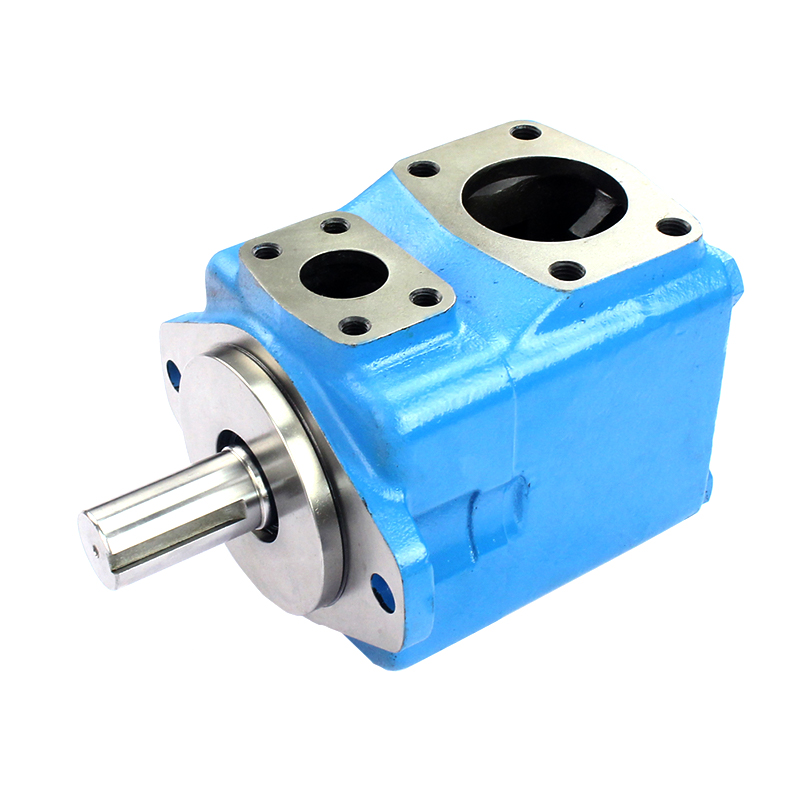
Vickers (Eaton Vickers) produces several distinct pump families, each with different internal geometry, performance characteristics, and testing considerations. Understanding which series you are working with is essential for applying correct test parameters and interpreting results against the right specifications.
| Pump Series | Type | Max Pressure | Displacement Range | Key Test Parameter |
|---|---|---|---|---|
| V / VQ Series | Fixed vane | 2,500 psi (172 bar) | 2.5–23 cc/rev | Volumetric efficiency at 2,000 psi |
| PVB Series | Variable piston | 3,000 psi (207 bar) | 5–45 cc/rev | Case drain flow + min/max displacement response |
| PVH Series | Variable piston | 5,000 psi (345 bar) | 57–141 cc/rev | Case drain flow, compensator response, overall efficiency |
| MFE / MFB Series | Fixed piston | 4,000 psi (276 bar) | 18–90 cc/rev | Volumetric efficiency across full pressure range |
| G Series (gear) | Fixed gear | 3,500 psi (241 bar) | 2–50 cc/rev | Flow at rated pressure, noise level |
Testing Vickers Variable Displacement Pumps: Additional Checks
Variable displacement models (PVB, PVH) require additional functional tests beyond flow and efficiency measurement. The pressure compensator — which reduces displacement to maintain a set pressure — must be verified to respond correctly and hold the set point stably. Compensator deadband should not exceed ±75 psi (5 bar) from the set point on a properly functioning PVH series pump. Sluggish or oscillating compensator response indicates worn spool seals, spring fatigue, or contaminated control passages.
Interpreting Test Results: What the Numbers Mean in Practice
Raw test data only becomes actionable when interpreted against defined acceptance criteria. The following reference ranges apply broadly to well-maintained hydraulic pump populations and align with Vickers/Eaton service documentation guidance.
| Test Parameter | Acceptable Range | Marginal / Monitor | Action Required |
|---|---|---|---|
| Volumetric efficiency | ≥ 90% | 85–89% | Below 85% — rebuild or replace |
| Overall efficiency | ≥ 87% | 82–86% | Below 82% — inspect bearings and shaft |
| Case drain flow (piston pumps) | 1–3% of rated output | 4–9% of rated output | ≥ 10% — immediate inspection required |
| Noise level at rated speed | < 72 dB(A) | 72–78 dB(A) | > 78 dB(A) — cavitation or bearing damage likely |
| Outlet pressure ripple | < 3% of mean pressure | 3–7% | > 7% — worn internals or air ingestion |
Common Failure Modes Found During Hydraulic Pump Testing
Testing rarely just confirms a pump is good or bad — it also points toward specific failure mechanisms. Recognizing these patterns reduces diagnostic time and guides repair decisions.
Cavitation
Cavitation occurs when fluid pressure at the pump inlet drops below the fluid's vapor pressure, causing vapor bubbles to form and then collapse violently as pressure recovers. Testing signatures include elevated noise (a characteristic grinding or rattling sound), erratic flow readings, and rapid performance degradation. Inlet vacuum exceeding 5 in Hg (17 kPa absolute) is a primary cavitation risk threshold for most Vickers pump designs. Root causes include clogged suction strainers, undersized suction lines, or fluid with excessive dissolved air.
Internal Wear (Vane and Port Plate Erosion)
In Vickers vane pumps, the vane tips and the cam ring surface wear together over time. Testing reveals progressive volumetric efficiency loss that worsens with increasing pressure — a flat efficiency curve that drops steeply above mid-range pressure is characteristic of vane tip wear. Port plate wear in piston pumps shows a similar pattern. Both conditions are confirmed by disassembly and direct measurement of clearances against manufacturer tolerances.
Contamination-Related Damage
Particle contamination is responsible for over 70% of hydraulic component failures according to industry studies. Abrasive wear from particles in the 5–15 micron range — invisible to the naked eye — accelerates clearance growth throughout the pump. Testing shows this as a general efficiency loss combined with increasing case drain flow. Oil analysis (particle counting per ISO 4406) should always accompany pump testing when contamination is suspected. Vickers specifications for most pump series call for ISO 4406 cleanliness of 16/14/11 or better for reliable service life.
Shaft Seal and Bearing Failure
Shaft seal failure is often identified during testing by external leakage at the shaft exit point, combined with elevated case drain flow. Bearing failure produces increased input torque (reduced mechanical efficiency) and often a distinct low-frequency rumble distinct from the higher-pitched noise of cavitation. Bearing failures in Vickers piston pumps are frequently traceable to misalignment between the pump and drive motor — an alignment error of more than 0.003 inches TIR (total indicator runout) significantly reduces bearing life.
Best Practices for Maintaining Vickers Hydraulic Pumps Between Tests
Testing identifies problems; preventive maintenance reduces their frequency. The following practices are drawn from Eaton Vickers service guidelines and established hydraulic systems maintenance standards.
- Maintain fluid cleanliness at or above the pump's specified ISO cleanliness class. For PVH series pumps operating at high pressure, this means ISO 16/14/11 or better. Use kidney loop filtration between shifts in demanding applications.
- Change hydraulic fluid on condition, not just by schedule. Use regular oil analysis to monitor viscosity, oxidation, and particle counts. Fluid that appears clean visually may be heavily contaminated in the 5–25 micron range that causes the most pump damage.
- Inspect and clean suction strainers at every fluid change. A partially blocked strainer is one of the most common causes of cavitation-induced pump failure — and one of the easiest to prevent.
- Verify shaft alignment whenever the pump is removed and reinstalled. Use a dial indicator to confirm TIR is within specification. Flexible couplings compensate for minor misalignment but should not substitute for correct installation.
- Never start a Vickers piston pump dry. Pre-fill the case with clean hydraulic fluid through the case drain port before initial startup or after any service that drained the pump housing. Running a piston pump dry even briefly causes immediate bearing and valve plate damage.
- Trend test results over time rather than evaluating each test in isolation. A pump at 91% volumetric efficiency is healthy — but if it was at 95% six months ago and 91% today, the downward trend warrants investigation before it crosses the action threshold.
When to Rebuild vs. Replace a Vickers Hydraulic Pump
Test results that fall below acceptable thresholds present a rebuild-versus-replace decision. For Vickers pumps, the economics generally favor rebuilding for larger, more expensive units and replacement for smaller fixed-displacement models.
- Rebuild is typically cost-effective for Vickers PVH and PVB series variable displacement pumps, where a factory-authorized rebuild costs 30–60% of a new unit price and restores the pump to factory performance specifications when performed correctly.
- Replace is more practical for V and VQ series vane pumps in smaller displacements, where new unit cost is relatively low and rebuild labor costs approach or exceed replacement cost.
- Regardless of the rebuild-or-replace decision, always address the root cause identified during testing before reinstalling any pump. A rebuilt or new pump installed into a system with contaminated fluid, a blocked strainer, or a misaligned drive will fail on the same timeline as the unit it replaced.