


 русский
 Español
 عربى


On a test stand, a 24 gpm power unit held a cylinder at 2,000 psi. The cylinder was not moving, but oil temperature rose 18°F in 20 minutes because the relief valve was passing most of the flow. A correctly set variable displacement hydraulic pump would have reduced displacement to the 8 gpm the circuit needed, cutting both bypass flow and heat.
That example gives the practical rule: a variable displacement pump is not automatically efficient. It saves energy only when its control mode, pressure setting, and duty cycle match the machine.
Content
How a Variable Displacement Hydraulic Pump Changes Flow
Displacement is the oil volume moved per revolution. Flow is displacement times shaft speed, adjusted for volumetric efficiency. A fixed pump has a set displacement. A variable pump changes displacement while running: a vane pump moves its cam ring to change eccentricity, while an axial piston pump changes swashplate angle.
Outlet pressure comes from resistance to flow, not from the pump alone. The relief valve still protects the circuit. The variable control decides how much flow the pump sends as pressure and demand change. That is why a pump can build full pressure and still overheat: it may be at maximum displacement when the machine only needs holding flow.
Fixed vs Variable: Where the Heat Comes From
At fixed displacement, excess flow must go somewhere. In a holding circuit it crosses the relief valve and turns pressure energy into heat. A variable pump can reduce displacement to match demand, so less oil crosses the relief. The benefit is largest when the machine holds, clamps, or waits between moves.
| Consideration | Fixed displacement pump | Variable displacement pump |
|---|---|---|
| Displacement | Set by pump geometry | Adjusted by cam ring or swashplate |
| Flow at a given speed | Nearly constant | Varies with control and demand |
| Heat during long holds | High if flow bypasses the relief | Lower when the pump destrokes |
| Initial cost | Usually lower | Higher, especially with electronic control |
| Contamination sensitivity | More forgiving | Control orifices and servo parts need clean fluid |
| Best fit | Constant flow, simple circuits | Variable duty, holding, multi-function loads |
In the opening example, 16 gpm crossing a relief at 2,000 psi is roughly 18.7 hydraulic horsepower, or about 14 kW, for the length of the hold. A pump that trims to 8 gpm removes much of that bypass heat. The saving shows up as lower oil temperature, less cooler demand, and lower engine or motor power.
Match the Control to the Duty Cycle
The pump body is only half the selection. The control decides when the pump strokes or destrokes, and the same pump can behave differently with two control options.
- Pressure compensation: reduces displacement after a set pressure; suits clamping and holding. Set a sensible deadband or it will hunt.
- Load sensing: holds a pressure margin above the highest load; common on multi-function mobile machines. Long sense lines or air can make it sluggish.
- Flow control: holds a set flow within limits; useful for stable actuator speed, but can still create excess pressure if the circuit does not unload.
- Power or torque limiting: reduces displacement as pressure rises to protect the prime mover; valuable on limited engine or electric motor torque.
- Electronic control: maps displacement to a controller for repeatability and diagnostics; adds sensors, calibration, and another failure mode.
Two settings often get confused. The pump compensator is a normal operating control; the relief valve is a safety limit. If the compensator is above the relief, the relief passes oil and heats the system. If it is too far below the load requirement, the machine stalls or moves slowly.
Selection Checks Before You Buy
Start with a duty cycle, not a catalog page. List each function, required flow, pressure, hold time, and which functions move together. Then check shaft speed, fluid viscosity, temperature, and contamination level. A pump selected only on maximum pressure and flow can be oversized for the work it does most of the day.
For mobile equipment, ask whether the operator needs simultaneous functions or precise holding. Load sensing usually fits a multi-function valve stack. Pressure compensation fits a clamp or single holding circuit. For a fixed-speed industrial power unit, a pressure-compensated pump often gives most of the benefit without electronic complexity.
Our variable displacement vane pump range is aimed at medium-pressure circuits that need a serviceable variable flow source.
 VPV Series Variable Displacement Vane PumpsVariable flow vane pumps for medium-pressure circuits, with pressure and flow adjustment, low-noise operation, and nominal flows from 12 to 40 L/min.View Product →
For heavier pressure and higher power density, an axial piston variable pump is often the better mechanical fit.
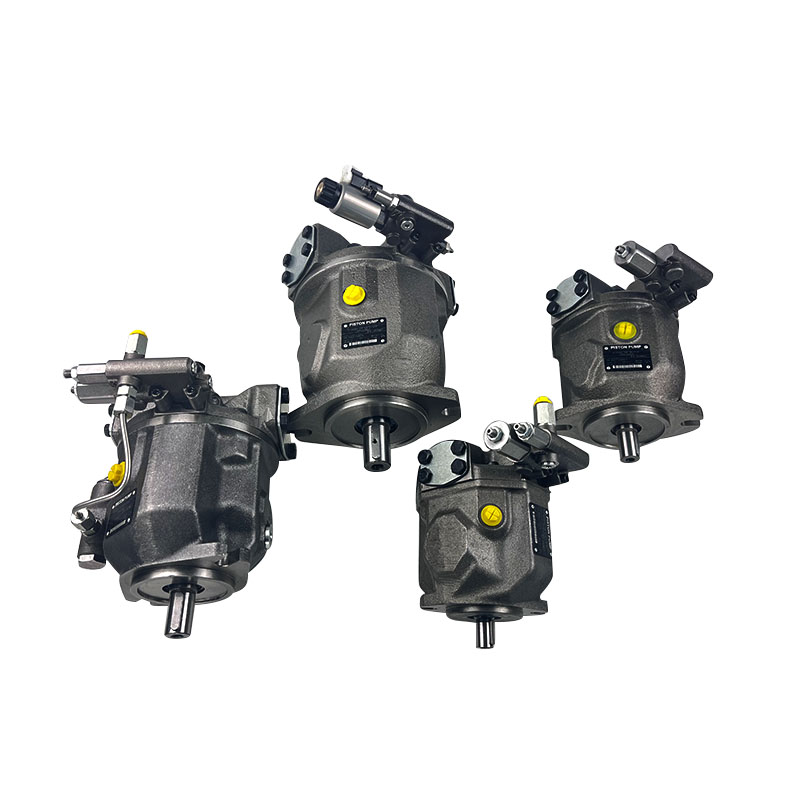 A10VSO 31 Series Axial Piston Variable PumpAxial variable piston pump for industrial open circuits, with continuous pressure up to 28 MPa and multiple control forms for demanding machinery.View Product →
The choice should follow pressure, speed, fluid cleanliness, and downtime cost, not a generic preference for one pump type. In construction machinery, variable pumps earn their place when a machine alternates between travel, lifting, and holding. A pump that follows load and operator demand can reduce heat and fuel use, but only when the valve block, cooling package, and control settings are integrated. Our construction machinery page shows where these circuits are used.
Installation, Commissioning, and Maintenance
Most variable pump problems appear as instability, slow response, or heat. Check the simple causes first: restricted inlet, air leak, wrong viscosity, clogged filter, and a blocked case drain. Controls use small orifices, so dirty oil can make a pump stick at full displacement.
- Flush and verify filtration; confirm airtight suction.
- Set relief first, then compensator or load-sense margin; check standby and maximum pressure with a calibrated gauge.
- Check response at normal oil temperature, not cold oil.
- Record settings and control type for the next technician.
- Monitor case drain flow and temperature after repair.
A pump that is oversized will still waste energy if the control keeps it at high displacement. A pump that is undersized runs at maximum displacement and may not reach actuator speed. Selection and commissioning belong together.
Cost, Payback, and Common Mistakes
A variable pump usually costs more than a fixed pump of similar size, and the gap grows with load sensing, electronic control, extra filtration, or a larger cooler. Payback comes from reduced bypass power, lower oil temperature, longer fluid life, and less demand on the prime mover. Use the real duty cycle, not one peak condition.
Common mistakes are predictable. Buyers compare only maximum pressure and flow, then find the pump spends most of its day at low demand. Technicians set the compensator above the relief, so the relief becomes the flow control. Maintenance teams use the wrong filter grade and blame the pump when a control orifice plugs.
A sensible specification states control type, pressure settings, standby flow, cleanliness target, allowable case drain, and expected duty cycle. That is more useful than a pump curve alone.
A variable displacement hydraulic pump earns its cost when it reduces flow during holding, waiting, or low-demand operation. It will not fix a circuit that is undersized, contaminated, or set up with the relief valve doing the control work. Start with the duty cycle, match the control, and commission pressure and flow with gauges. That sequence delivers the lower heat and energy use that made the variable pump worth considering.