


 русский
 Español
 عربى


A 1,800 rpm power unit that is quiet at 12 MPa can turn into a 76–80 dB problem at 21 MPa if the vane pump type is wrong for the duty cycle. The practical answer is to choose the pump architecture from the job: fixed or variable displacement, single or multi-flow, pin-vane or intra-vane, cartridge or complete unit, and standard or steering-duty. That choice controls flow stability, heat, noise, startup behavior, and how much of the machine has to be removed when the pump eventually wears.
Below is a type-by-type breakdown for buyers and maintenance engineers who need to compare a catalog number with the real circuit, not just match mounting dimensions.
Content
- 1 The First Decision: Fixed or Variable Displacement
- 2 Single, Double, and Triple Vane Pumps
- 3 Inside the Pump: Pin-Vane, Intra-Vane, Cartridge, and Through-Shaft Designs
- 4 A Practical Comparison of Common Vane Pump Types
- 5 Matching the Type to Construction and Industrial Duty
- 6 Specification Checklist Before You Buy
The First Decision: Fixed or Variable Displacement
Fixed displacement is the simpler vane pump type. It delivers a nearly constant volume per revolution, so flow rises and falls with drive speed. At 1,800 rpm, a 20 cc/rev pump gives roughly 36 L/min before slip losses. That is predictable and usually lower cost, but if the circuit holds pressure for long periods, excess flow crosses the relief valve and turns into heat. A pressure-compensated variable vane pump reduces displacement as the set pressure is approached, so it can hold a clamp or press without burning 10–20 kW in the relief path.
Variable pumps are not automatically better. They add a compensator, a setting screw, and a need for cleaner oil; a contaminated control orifice can cause sluggish response or pressure overshoot. For a machine that always uses full flow, fixed displacement is often more cost-effective. For long hold, clamp, or accumulator-charging duty, variable displacement is the more defensible choice.
 VPV Series Variable Displacement Vane PumpsVariable-flow vane pump with adjustable pressure and flow, suited to machine tools and systems needing pressure holding or lower power loss.View Product →
Single, Double, and Triple Vane Pumps
A single pump has one inlet and one outlet. A double pump shares a drive shaft and often a common inlet, but delivers two independent outlet flows; a triple adds a third. This is useful when one power unit must supply, for example, a 12 L/min pilot circuit and a 40 L/min actuator circuit at different pressures. The circuits stay hydraulically separate, which is cleaner than splitting one flow with a priority valve when the pressure demands are far apart.
The purchasing risk is treating a double or triple pump as a simple flow adder. Check shaft torque, the maximum pressure difference between outlets, case-drain routing, and port orientation. In a tandem stack, the rear pump may have a lower pressure rating than the front pump; using the same relief setting on both can shorten life. If one section fails, confirm whether the whole unit must be replaced or whether a cartridge repair is possible. The flow from each outlet still depends on the same pressure-generating action, which is explained in how vane pumps create pressure and flow.
Inside the Pump: Pin-Vane, Intra-Vane, Cartridge, and Through-Shaft Designs
Vane pumps all use vanes sliding in a rotor, but the vane retention method changes startup and low-speed behavior. Pin-vane designs use pins under the vanes to keep them against the cam ring when centrifugal force is low; that can improve priming and low-speed response, but the pins and vane slots are extra wear points. Intra-vane designs route pressure to the underside of the vane; they often run quieter and load the cam ring more evenly, but they are less tolerant of dirty oil and a worn intra-vane can produce a pressure-dependent noise change.
A cartridge pump is a complete pumping insert: rotor, vanes, cam ring, side plates, and seals in one serviceable assembly. It can shorten downtime when the housing and shaft are still good, but the cavity and mating surfaces must be within specification. Through-shaft designs allow two or more pump sections to be driven in series from one motor, which saves space but requires careful alignment and coupling balance. For maintenance planning, compare the price of a cartridge with the labor cost of a full pump change; on a 24/7 press, the faster repair often matters more than the part price.
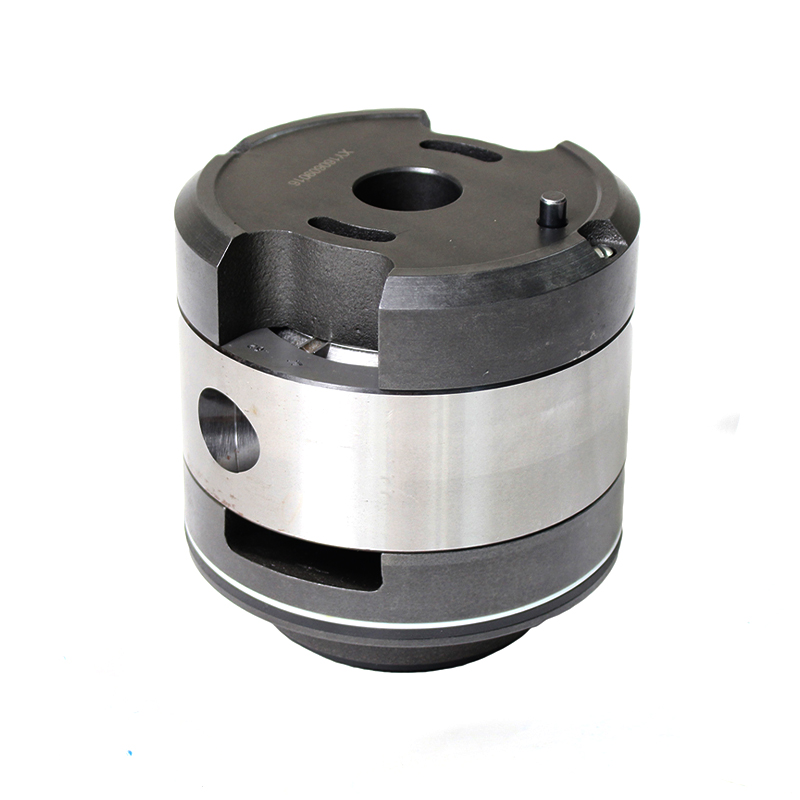 T6/T7 Cartridge Vane Pump ComponentsDouble-lip cartridge vane pump assembly with single locating pin, intended for maintenance and reliable hydraulic performance in industrial applications.View Product →
A Practical Comparison of Common Vane Pump Types
The table below is a starting point for circuit review. Final selection still depends on fluid viscosity, duty cycle, and the pump's published continuous and peak pressure limits.
| Vane pump type | Flow behavior | Typical fit | Procurement watch-out |
|---|---|---|---|
| Fixed single | Flow follows drive speed | Continuous actuator motion, simple transfer | Relief-valve heat during long holds |
| Pressure-compensated variable | Flow falls near the pressure setting | Clamp, press, accumulator charging | Control orifice cleanliness and setting accuracy |
| Double or triple | Two or three independent flows | Multi-function power units | Shaft torque, pressure difference, port orientation |
| Pin-vane | Pins keep vanes out at low speed | Cold start and low-speed duty | Pin wear and vane-slot wear |
| Intra-vane | Pressure-loaded vanes | Low-noise industrial circuits | Filtration sensitivity |
| Cartridge | Replaceable pumping insert | Fast repair of a sound housing | Cavity wear must be measured |
| Through-shaft | Series-mounted pump sections | Compact multi-pump drive | Alignment and coupling balance |
| Steering pump | Priority flow for steering | Mobile machinery | Engine-speed flow curve and fallback behavior |
Matching the Type to Construction and Industrial Duty
On construction machinery, the pump rarely sees one steady speed. A fixed-displacement steering pump may be sized for a 1,200 rpm idle and then run at 2,200 rpm at travel speed, so the flow curve and relief setting must be checked across the whole engine map. Steering circuits also need priority flow and a safe manual-steer fallback; a pump that matches displacement but not the priority valve can feel heavy at idle or noisy at high speed. For an overview of how these pumps fit mobile equipment, see construction machinery applications.
 V10 and V20 Single Steering PumpsSingle steering pump with HT300 body and interchangeable Ping Jian or spline shaft, aimed at plastic, injection molding, cutting, and press machinery.View Product →
Industrial power units have a different profile: long clamp, press, or accumulator cycles at fixed motor speed. Here the variable pump's pressure compensator often pays back through lower oil temperature and smaller cooling packages. For a simple transfer or lubrication circuit, a fixed single pump is usually the lower-risk, lower-cost choice.
Specification Checklist Before You Buy
Compare these values on the datasheet and on the machine nameplate, not only on the catalog cover:
- Displacement in cc/rev and expected flow at the actual drive speed; slip and volumetric efficiency change with pressure and viscosity.
- Continuous and peak pressure ratings, plus the relief valve setting and whether the peak occurs every cycle or only in a stall.
- Speed range, minimum priming speed, and whether the pump will run at engine idle for long periods.
- Fluid viscosity range, recommended oil grade, and cleanliness target; a 10 µm filter may be needed for a variable or intra-vane unit where a fixed pump would tolerate more contamination.
- Mounting pilot, shaft type, port orientation, rotation, and case-drain limit; a 0.5–1 bar case-drain limit is common on small pumps, but confirm the exact model.
- Noise target and test condition; a low-noise claim at 1,450 rpm and 7 MPa does not predict sound pressure at 2,200 rpm and 21 MPa.
- Service plan: cartridge availability, seal kit lead time, and whether the housing can be reused after a wear check.
The most common procurement error is mixing a high-pressure catalog rating with a low-pressure duty cycle and then blaming the pump for heat or noise. The second most common is replacing a worn double pump with a single pump plus a flow divider, which changes both pressure drop and controllability. Match the type to the circuit first, then confirm the mounting and service path.