


 русский
 Español
 عربى
عربى

A hydraulic pump does the same basic job in every machine: it turns shaft rotation into oil flow. What changes from one type to the next is how much pressure that flow can support, how quietly it runs, how well it tolerates contaminated oil, and what it costs to buy and to keep running. On most industrial and mobile equipment the shortlist comes down to three families, and each one wins a different part of that trade-off.
Content
- 1 The Short Answer: Pressure, Cleanliness, and Duty Cycle Choose the Family
- 2 How the Three Main Hydraulic Pump Types Compare
- 3 Gear Pumps: Simple, Tolerant, and Cheap to Own
- 4 Vane Pumps: Quiet, Stable Flow at Mid Pressure
- 5 Piston Pumps: High Pressure, High Efficiency, Higher Upkeep
- 6 Fixed or Variable Flow, Single or Multiple
- 7 Where the Choice Lands on Construction Machinery
- 8 Selection Checklist Before You Order
The Short Answer: Pressure, Cleanliness, and Duty Cycle Choose the Family
If you need to narrow the field quickly, this is roughly where the decision lands:
- Gear pumps win on cost, simplicity, and tolerance of dirty oil, which keeps them the default for fixed-flow circuits up to roughly 250 bar.
- Vane pumps win on quiet operation and steady flow at mid pressure, typically 100 to 210 bar, with balanced designs that cancel radial shaft loads.
- Piston pumps win when pressure climbs past 250 bar or when efficiency, precise control, and long life under heavy duty cycles matter more than purchase price.
Everything below explains why those boundaries sit where they do, where they shift in practice, and which details in a datasheet actually decide whether the pump survives three years or ten.
How the Three Main Hydraulic Pump Types Compare
| Pump type | Typical continuous pressure | Efficiency at rated pressure | Dirt tolerance | Noise | Relative purchase cost | Common fit |
|---|---|---|---|---|---|---|
| Gear (external or internal) | Up to about 250 bar | 80 to 90 percent | High; copes with coarse filtration | Moderate to high | Low | Power packs, transfer circuits, simple mobile functions |
| Vane (balanced, single or multiple) | About 100 to 210 bar, higher for high-pressure series | 85 to 93 percent | Medium; needs clean oil | Low | Medium | Machine tools, injection moulding, steering, mid-pressure mobile circuits |
| Piston (axial or radial) | 250 to 400 bar, higher for radial designs | 90 to 95 percent | Low; requires fine filtration | Moderate | High | High-pressure mobile equipment, presses, winches, closed-loop drives |
Gear Pumps: Simple, Tolerant, and Cheap to Own
A gear pump traps oil between the teeth and the housing wall and carries it around the casing to the outlet. Two meshing gears, two bearing sets, and a seal kit make up almost the entire machine. External gear pumps are the classic form. Internal gear pumps place a smaller pinion inside a larger ring gear, which smooths the flow and cuts noise, though the internal design costs more to machine.
Three practical consequences follow. First, pressure capability tops out around 200 to 250 bar continuous, because the load on the bearings and the casing grows directly with pressure. Second, the pump is fixed displacement: flow depends only on speed, so any change in demand has to be handled by a valve, not by the pump itself. Third, gear pumps fail gradually. As clearances open up, internal leakage rises, flow drops at high pressure, and the oil heats up, but the machine usually keeps working until the loss becomes obvious.
That makes a gear pump the right answer when flow is fixed, filtration cannot be guaranteed, or first cost dominates the decision. Log splitters, dump circuits, small loaders, and standby power packs all live comfortably in that zone.
Vane Pumps: Quiet, Stable Flow at Mid Pressure
Inside a vane pump, rectangular blades slide in and out of slots in a rotor, and centrifugal force combined with port pressure keeps the tips pressed against a cam ring. In a balanced design, two intake arcs and two discharge arcs sit opposite each other, so the radial loads on the shaft cancel out. That balance is exactly what lets a vane pump generate pressure and flow at higher pressure than a comparable gear pump while running noticeably quieter.
Two details decide how a given vane pump behaves. The cam ring profile sets displacement and the shape of the flow curve, so a variable-displacement ring can change output to match demand. The blade tip sets the seal: a double-lip blade structure grips the ring more tightly as pressure rises, which reduces slip and holds volumetric efficiency in the upper eighties even at the top of the pressure band.
Denison-style T6 and T7 pumps are a good reference point for the family. A single pump covers straightforward circuits, and the same rotor and ring geometry scales up into double and triple configurations when one housing has to feed several functions. SherTech builds this range in its Denison-compatible line.
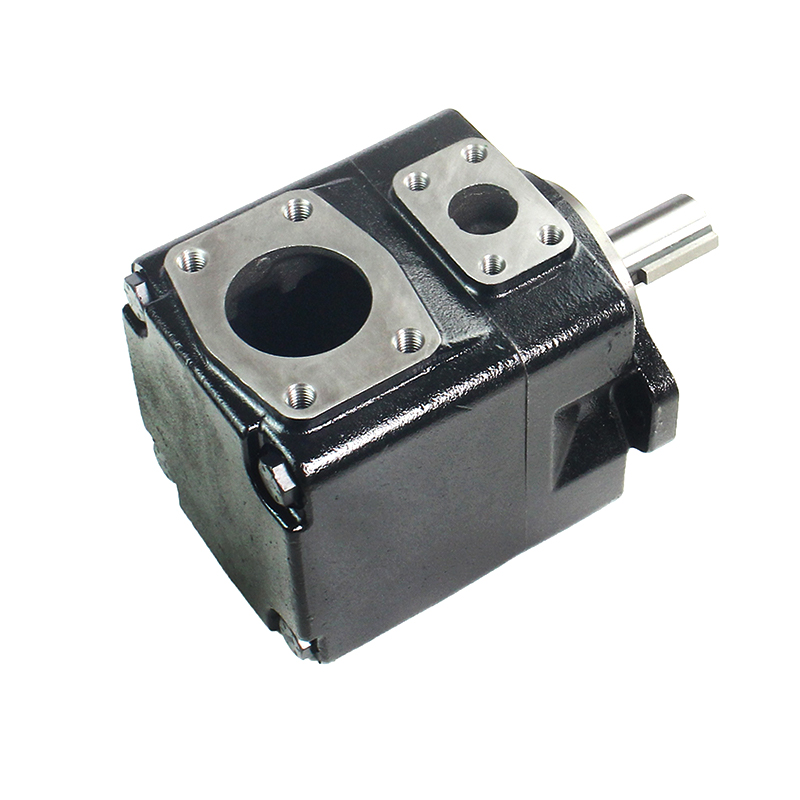 Denison T6/T7 Single Vane Pump for Hydraulic CircuitsFixed-displacement balanced vane pump with independent cartridge and OEM cross-reference; relevant where low-ripple hydraulic circuits and multiple configurations are considered.View Product →
Noise is often the deciding factor on machinery that runs beside an operator all day. Low-noise vane pumps reduce pressure ripple by tuning the porting geometry so that the transition between suction and discharge is gradual rather than abrupt. The gain is not cosmetic: lower ripple means less vibration in the piping, longer hose life, and less fatigue for anyone standing next to the machine.
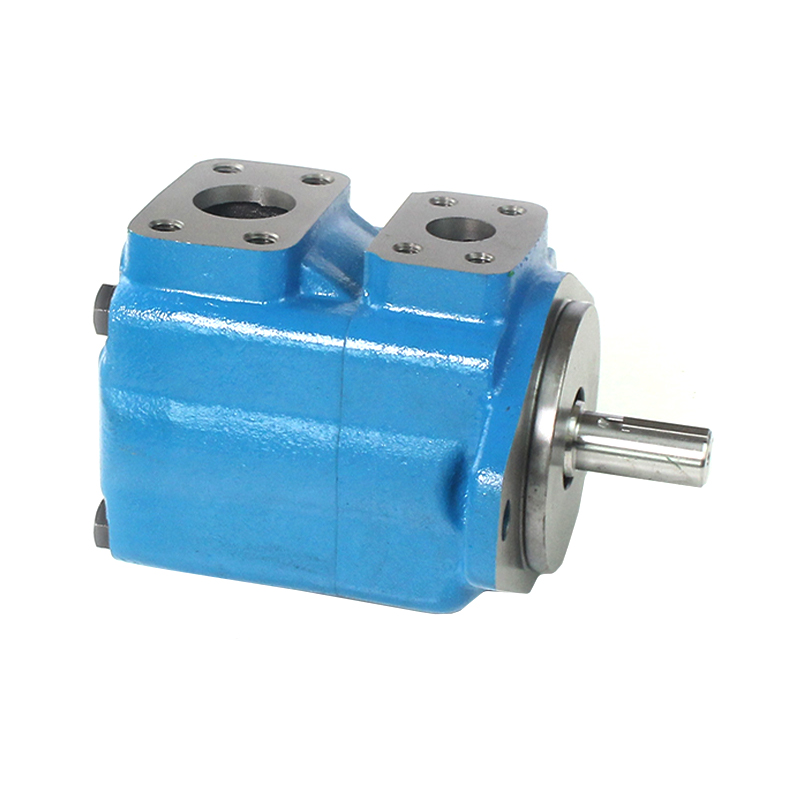 Vickers-Style V Series Low Noise Single Hydraulic Vane PumpLow-noise intra-vane pump suited to machine tools and industrial hydraulic systems; relevant where quiet operation and compact installation are priorities.View Product →
Vane pumps earn their place in injection moulding machines, machine tools, and mid-pressure mobile circuits. Steering pumps are a specialised branch of the same family, usually running lower pressure with a priority flow valve built into the circuit so that the steering function always gets oil first.
Piston Pumps: High Pressure, High Efficiency, Higher Upkeep
Piston pumps replace sliding blades with pistons running in bores in a rotating cylinder block. In an axial design, a swashplate or a bent axis sets the piston stroke; in a radial design, pistons push outward against a stationary ring. Axial pumps dominate mobile equipment because they are compact and can be made variable with a simple control. Radial pumps handle the highest pressures but take up more space.
The benefits are real. Volumetric and overall efficiency of 90 to 95 percent at rated pressure means less heat dumped into the oil, which allows a smaller reservoir and a smaller cooler. Variable displacement with load sensing or pressure compensation matches flow to demand, so the machine only consumes the power it actually needs.
The cost side is equally real. Piston pumps need ISO 18/16/13 oil or better, and a single burst of abrasive contamination can score a cylinder bore or a valve plate beyond repair. They are also the most expensive family to buy and to rebuild, which is why they are usually reserved for the functions that genuinely need the pressure.
A10VSO-style swashplate pumps are the standard choice for high-pressure variable circuits, with through-drive options that let a second pump be mounted on the same shaft.
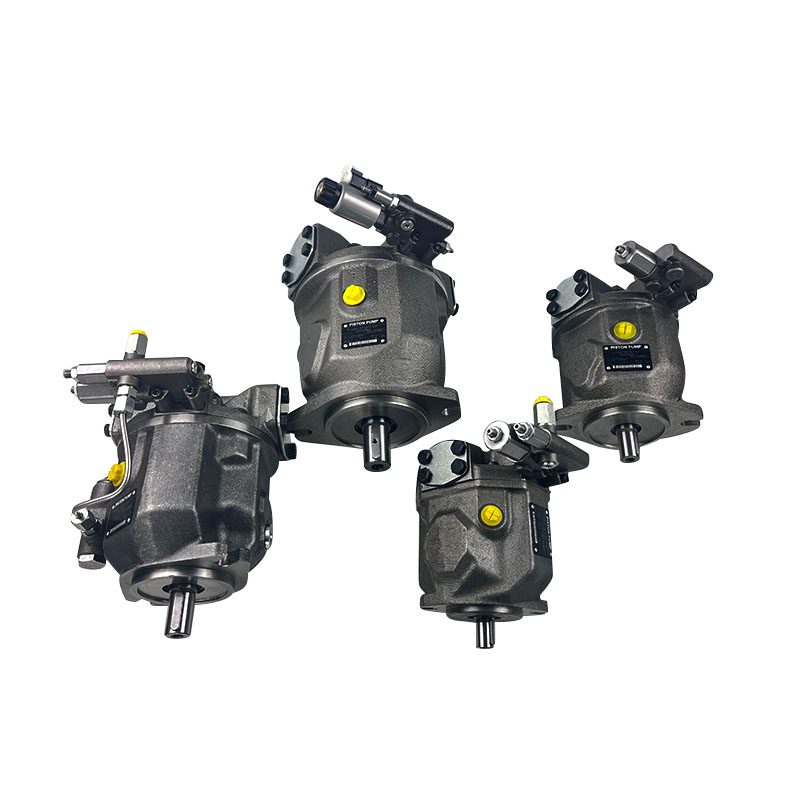 A10VSO 31 Series Axial Variable Piston PumpAxial variable pump for industrial open circuits, with swashplate flow adjustment and through-shaft options; relevant where variable displacement and pressure control are considered.View Product →
Fixed or Variable Flow, Single or Multiple
Displacement control cuts across all three families, and it is often a bigger decision than the pump type itself. A fixed pump delivers flow proportional to shaft speed and nothing else, so a relief valve has to dump the surplus. That is cheap and predictable, but it wastes energy as heat. A variable pump adjusts displacement to hold a set pressure or a set flow, which saves power and reduces oil temperature on machines with long holding phases.
Mounting arrangements come next. Double pumps combine two displacements in one housing, triple pumps add a third, and through-shaft designs allow a rear pump to be driven from the front unit. The benefit is one mounting pad, one drive coupling, and one oil supply instead of three separate machines.
Cartridges and spare parts
Wear parts are another angle worth checking before ordering. In vane pumps, the rotor, blades, cam ring, and side plates are sold as a cartridge that slides into the existing housing. Replacing a cartridge restores original flow and pressure for a fraction of the price of a complete pump, which changes the total cost of ownership considerably over a ten-year service life.
Where the Choice Lands on Construction Machinery
Mobile equipment shows all three families working side by side on the same machine. A wheel loader or excavator typically uses a piston pump for the main implement circuit, a gear or vane pump for pilot and auxiliary functions, and a dedicated steering pump for the priority steering circuit. Each function gets the pump type that matches its pressure, flow, and contamination risk.
Duty cycle is the other half of the picture. A pump running at full pressure for ten seconds out of every minute sees a completely different thermal load from one holding pressure for hours. Mobile circuits also deal with wide viscosity swings between a cold morning start and a hot afternoon shift, so the suction condition at low temperature matters as much as the pressure rating on the datasheet. For more on how these pumps are applied across the sector, see the overview of construction machinery hydraulics.
Selection Checklist Before You Order
Once the family is settled, work through the following points in order. Missing one of them is how good pumps end up failing early.
- Pressure and flow: confirm continuous pressure, peak pressure, and the flow needed at rated shaft speed, not at idle.
- Displacement control: decide between fixed, pressure-compensated, and load-sensing control based on the holding phases in the cycle.
- Mounting and shaft: check flange standard, pilot diameter, shaft type, key or spline, and rotation direction.
- Porting: verify port sizes and positions against the existing manifold or hose routing before committing.
- Fluid and viscosity: match the pump to the oil in use, including the cold-start viscosity on the coldest morning of the year.
- Filtration: gear pumps tolerate coarse filtration, vane pumps need clean oil, and piston pumps need fine filtration with a properly sized suction strainer.
- Thermal load: estimate heat generation from leakage and relief losses so the reservoir and cooler are not undersized.
- Service strategy: price out cartridges, seal kits, and replacement units before buying, not after the first failure.
SherTech Hydraulic has been manufacturing hydraulic components since 1990, with more than three decades of design and customisation experience behind its range. The catalogue covers vane pumps in Denison, Vickers, Yuken, Atos, and Tokimec compatible series, piston pumps and motors, vane motors, steering pumps, solenoid valves, relief valves, cold-drawn cylinder tube, and complete hydraulic systems built to a specific duty cycle. With several hundred component types and more than 600 projects delivered, the practical value for a buyer is straightforward: one supplier can match a pump to an existing circuit or design the whole power unit around it.
If the choice between gear, vane, and piston still looks close after working through the checklist, send the working pressure, flow demand, duty cycle, and fluid specification. Those four numbers usually settle the question quickly.