


 русский
 Español
 عربى
عربى

Content
- 1 The Role of Hydraulic Pumps and Motors in Modern Industry
- 2 How Hydraulic Pumps Work: Converting Mechanical Energy into Flow
- 3 Types of Hydraulic Pumps: Gear, Vane, and Piston
- 4 How Hydraulic Motors Work: Turning Fluid Power into Rotation
- 5 Types of Hydraulic Motors: Vane, Piston, and Gerotor
- 6 Key Performance Parameters for Pump and Motor Selection
- 7 Industrial Applications: Where Pumps and Motors Deliver the Most Value
The Role of Hydraulic Pumps and Motors in Modern Industry
Hydraulic systems are the invisible backbone of modern industrial production. From the excavator breaking ground on a construction site to the injection molding press shaping plastic components at thousands of cycles per day, the ability to generate, transmit, and control enormous forces through pressurized fluid defines how heavy industry operates. At the center of every such system sit two complementary components: the hydraulic pump and the hydraulic motor.
These two devices are, in one sense, mirror images of each other. A hydraulic pump takes mechanical energy — typically from an electric motor or internal combustion engine — and converts it into hydraulic energy in the form of pressurized fluid flow. A hydraulic motor does the opposite: it receives that pressurized flow and converts it back into mechanical rotation. Together, they form the energy input and output of a complete fluid power transmission chain.
The relationship between pump and motor determines the efficiency, responsiveness, and power density of the entire system. Selecting the wrong type, or mismatching their specifications, introduces energy loss, premature wear, and unpredictable behavior under load. Understanding how each component works — and how to choose the right combination — is therefore essential knowledge for any engineer, procurement specialist, or maintenance professional working with hydraulic equipment.
How Hydraulic Pumps Work: Converting Mechanical Energy into Flow
A hydraulic pump does not create pressure by itself. What it creates is flow — a controlled movement of hydraulic fluid from the reservoir into the circuit. Pressure is a consequence of resistance to that flow: the more resistance the system presents (through load, valves, or actuators), the higher the pressure the pump must generate to maintain the specified flow rate.
All positive-displacement hydraulic pumps — the dominant category in industrial applications — operate on the same fundamental principle: a series of enclosed chambers cyclically expands at the inlet (drawing fluid in) and contracts at the outlet (forcing fluid out). The geometry of how those chambers are formed defines the pump's type, and with it, its characteristic pressure range, noise level, efficiency curve, and suitability for different applications.
Two circuit architectures are in common use. In an open circuit, the pump draws fluid from a reservoir, delivers it to actuators through control valves, and the fluid returns to the reservoir after each work cycle. In a closed circuit, the motor's outlet is connected directly back to the pump inlet without passing through the reservoir, allowing much faster response and higher operating speeds — a configuration commonly used in mobile equipment hydrostatic transmissions. Each architecture places different demands on the pump, particularly regarding case drain, charge pressure, and thermal management.
Types of Hydraulic Pumps: Gear, Vane, and Piston
Three pump families account for the vast majority of industrial and mobile hydraulic applications. Each offers a distinct balance of pressure capability, volumetric efficiency, noise, and cost.
Gear pumps are the simplest and most cost-effective option. Two meshing gears rotate inside a close-tolerance housing; fluid is trapped in the spaces between gear teeth and the housing wall, then carried from inlet to outlet. Gear pumps handle pressures up to approximately 3,500 psi and speeds up to 3,600 rpm, making them well suited to agricultural equipment, log splitters, and general industrial machinery where moderate pressure and high reliability at low cost matter most. Their main limitations are higher noise levels and fixed displacement — the output flow cannot be varied without changing shaft speed.
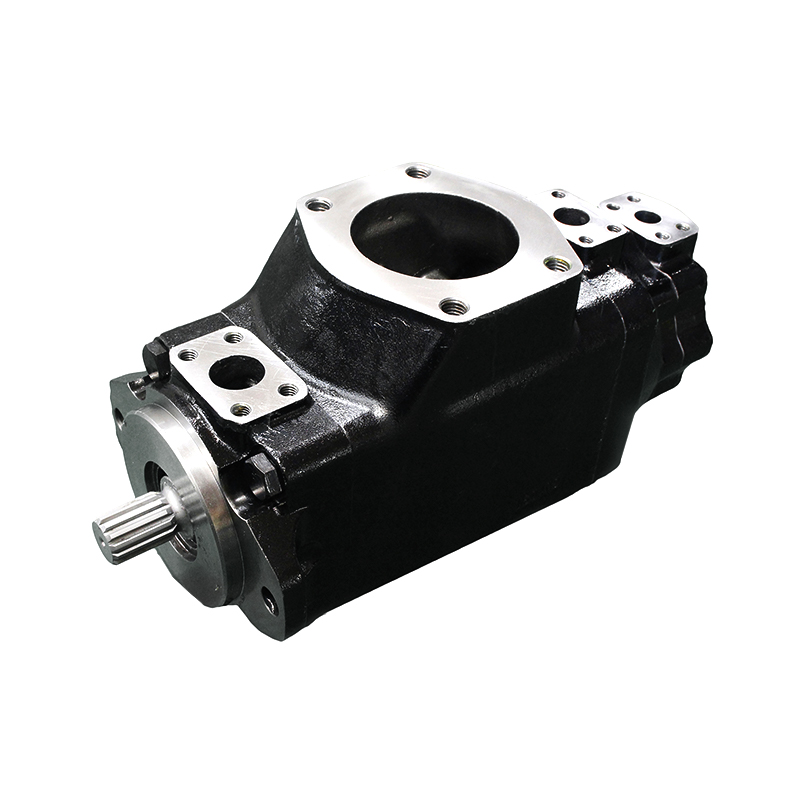
Vane pumps use a rotor with radially sliding vanes that press against an elliptical cam ring. As the rotor turns, the vanes sweep fluid from the low-pressure inlet side to the high-pressure outlet side. Compared to gear pumps, vane pumps offer meaningfully lower noise levels, smoother flow, and higher volumetric efficiency at medium pressures — typically up to 4,000 psi in high-performance pin-type designs. They are the preferred choice for machine tools, plastic machinery, and power steering systems where quiet operation and consistent delivery are priorities. Balanced vane pump designs, with two inlet and two outlet ports positioned diametrically opposite, also eliminate the side loading on the shaft and bearings that limits the service life of unbalanced designs.
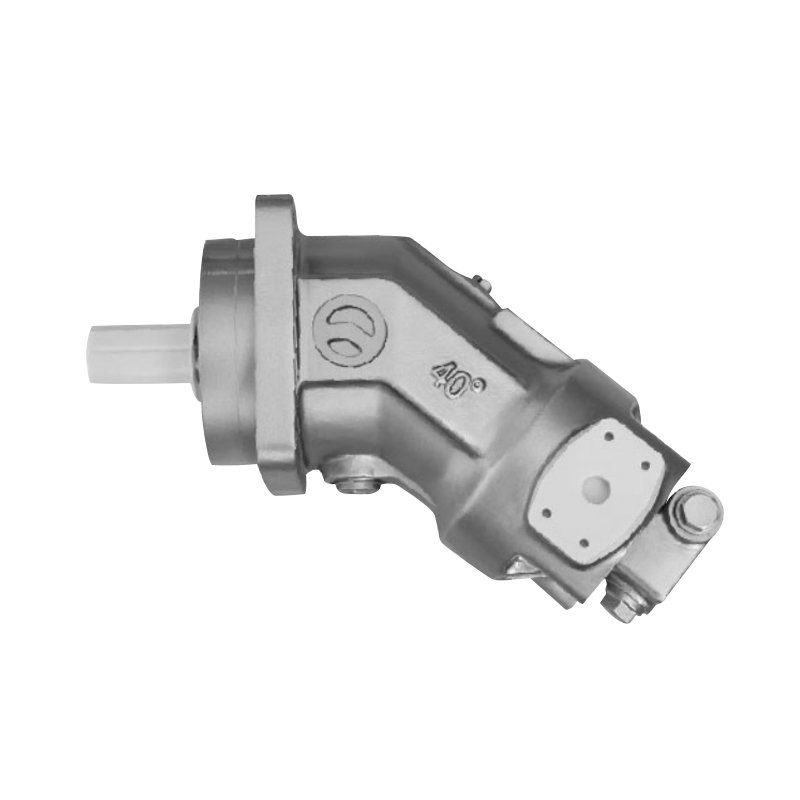
Piston pumps deliver the highest performance across all metrics: pressures exceeding 6,000 psi, variable displacement capability, and the best volumetric and overall efficiency of any pump type. Axial piston pumps use a rotating barrel of pistons whose stroke length is controlled by the angle of a swash plate — tilting the plate increases or decreases displacement continuously, allowing precise flow control independent of shaft speed. This variable displacement capability makes piston pumps the standard choice in sophisticated closed-loop systems, construction machinery, and industrial presses where energy efficiency and precise control over force and velocity are critical requirements. Their higher manufacturing complexity and cost position them at the premium end of the market, but the total cost of ownership advantage over gear pumps in high-duty-cycle applications is well established.
How Hydraulic Motors Work: Turning Fluid Power into Rotation
A hydraulic motor is conceptually the reverse of a hydraulic pump. Pressurized fluid enters the motor, acts on internal rotating elements — gears, vanes, or pistons — and exits at lower pressure after transferring its energy as torque to the output shaft. The shaft drives whatever mechanical load the system requires: a conveyor, a winch drum, a wheel hub, a mixing auger, or a machine tool spindle.
While a pump and a motor of the same family often share similar internal geometry, they are not simply interchangeable in practice. A hydraulic motor must be designed to handle working pressure at both ports simultaneously — it must be able to rotate in either direction under full load, and it must seal effectively against the high-pressure side while the low-pressure side is connected to return. Most hydraulic pumps, by contrast, rely on near-atmospheric inlet pressure and would leak internally or fail structurally if operated in reverse under load.
The key output parameters for a hydraulic motor are torque and rotational speed. Torque is proportional to pressure and displacement; speed is proportional to flow rate divided by displacement. This relationship means that a high-displacement motor produces high torque at low speed for a given flow rate, while a low-displacement motor produces low torque at high speed. Matching these characteristics to the load requirement — and to the pump's output — is the central task of hydraulic system design.
Types of Hydraulic Motors: Vane, Piston, and Gerotor
Just as with pumps, hydraulic motors are available in three main configurations, each suited to different speed, torque, and efficiency requirements.
Vane motors are characterized by smooth, quiet operation and moderate torque output. Pressurized fluid enters the motor and acts on the exposed surface area of the vanes, driving the rotor. Vane motors perform best at medium speeds and are widely used in industrial automation, conveyor systems, and machine tool applications where low noise and steady rotation are valued. Their starting torque is somewhat lower than piston designs, which limits their use in applications requiring high breakaway force from standstill.
Piston motors — available in axial and radial configurations — cover the widest performance range and are the preferred choice for demanding applications. Axial piston motors achieve usable speeds from below 50 rpm to above 14,000 rpm with high efficiency throughout the range, making them suitable for both high-speed spindle drives and precise low-speed positioning systems. Radial piston motors, particularly multi-lobe cam ring types, excel at very low speeds with very high torque — a combination called low-speed high-torque (LSHT) performance — making them ideal for direct-drive wheel motors in heavy mobile equipment, winches, and anchor handling systems where gearboxes would otherwise be required. Piston motors carry a higher unit cost but deliver superior efficiency and longevity under sustained high-load operation.
Gerotor and geroler motors (also known as orbital motors) use an inner rotor with one fewer tooth than the outer ring, rotating eccentrically to create expanding and contracting fluid chambers. They are compact, simple, and cost-effective low-speed high-torque devices, widely specified in agricultural equipment, small construction tools, and material handling machinery. Their speed range is more limited than axial piston motors, but their robust simplicity and tolerance for contaminated fluid make them a practical choice in cost-sensitive mobile applications.
Key Performance Parameters for Pump and Motor Selection
Selecting the right hydraulic pump and motor combination requires matching a set of interdependent specifications to the demands of the application. The following parameters form the core of any selection process.
Displacement — expressed in cc/rev (cubic centimeters per revolution) — defines how much fluid the pump delivers or the motor consumes per shaft revolution. For variable-displacement machines, the range from minimum to maximum displacement defines the controllable operating envelope. Displacement directly determines the torque output of a motor at a given pressure and the flow output of a pump at a given speed.
Operating pressure is the continuous working pressure rating of the component, distinct from the peak or intermittent pressure rating. Specifying components at or beyond their continuous pressure rating accelerates wear on seals, bearing surfaces, and porting faces. A common design practice is to select components rated for at least 20–30% above the system's expected maximum working pressure to provide a meaningful safety margin.
Volumetric efficiency measures how closely the actual fluid delivery of a pump (or consumption of a motor) matches its theoretical displacement-based value. Internal leakage — fluid slipping back across clearances from high-pressure to low-pressure zones — reduces volumetric efficiency and generates heat. High-quality vane and piston designs achieve volumetric efficiencies above 95% at rated conditions; worn or poorly manufactured components may fall below 85%, causing significant energy waste and system overheating.
Noise level is an increasingly important specification in manufacturing environments subject to occupational noise regulations. Vane pumps consistently outperform gear pumps in noise generation at comparable pressure and flow conditions. Pin-type vane pump designs, in particular, reduce pressure pulsation at the outlet — the primary source of hydraulic noise — through more uniform vane loading during the transition between suction and discharge zones.
Overall (total) efficiency is the product of volumetric efficiency and mechanical efficiency. It directly determines how much input power is converted into useful hydraulic power versus lost as heat. In high-duty-cycle systems operating many hours per day, even a 3–5% difference in overall efficiency translates into meaningful energy cost differences over the equipment's service life and significantly affects heat exchanger sizing requirements.
Industrial Applications: Where Pumps and Motors Deliver the Most Value
Hydraulic pumps and motors are specified across a remarkably wide range of industries, each placing distinct demands on component performance.
In construction machinery — excavators, wheel loaders, cranes, and concrete pumps — the combination of high power density, tolerance for shock loading, and operation in harsh outdoor environments makes hydraulics the dominant power transmission technology. Variable-displacement piston pumps in closed-loop hydrostatic drives enable the precise, continuously variable speed control that modern machines require, while high-torque radial piston motors deliver the wheel or track drive forces needed to move heavy equipment over rough terrain.
In plastic injection molding, hydraulic systems must deliver very high clamping forces — often thousands of kilonewtons — with precise positional control during mold closing and opening, and fast, accurate pressure control during the injection and holding phases. Vane pumps are widely used in this segment for their low noise (critical in factory environments) and high volumetric efficiency at medium pressures. Variable-displacement systems with pressure-compensated controls significantly reduce energy consumption compared to fixed-displacement designs running against a relief valve.
In metallurgical and mining equipment, hydraulic crushers, presses, and underground support systems demand components that deliver high forces reliably in environments with extreme temperature variation, vibration, and potential fluid contamination. Robust construction, high-quality sealing systems, and broad temperature-range hydraulic fluids are all selection criteria that take priority over cost minimization in this segment.
In agricultural machinery — tractors, combine harvesters, and self-propelled sprayers — the hydraulic system must power steering, implement lift, and hydrostatic ground drive simultaneously from a single power source. Gear pumps and low-cost gerotor motors dominate in simpler machines, while more sophisticated equipment increasingly specifies variable-displacement solutions to improve fuel efficiency and operator comfort.
The common thread across all these applications is that pump and motor performance directly determines the productivity, efficiency, and reliability of the end equipment. Working with manufacturers who apply rigorous quality management standards — covering raw material selection, precision machining tolerances, volumetric efficiency testing, and noise validation — is the most reliable path to hydraulic components that perform as specified across the full service life of the machine.