


 русский
 Español
 عربى
عربى

Hydraulic pump symbols are standardized graphical representations used in hydraulic circuit diagrams (schematics) to identify the type, flow direction, and control method of a pump without written description. Reading them correctly is essential for anyone designing, troubleshooting, or maintaining a hydraulic system. Among the many pump types represented in these schematics, the PTO (Power Take-Off) powered hydraulic pump is one of the most practically important — used extensively in agriculture, trucking, construction, and emergency services where a vehicle's engine drives hydraulic work functions directly.
This article explains how to interpret hydraulic pump symbols accurately, covers the key symbol variations you will encounter, and then goes into practical depth on PTO powered hydraulic pumps — how they work, what specifications matter, and how to select the right one for a given application.
Content
- 1 How to Read the Basic Hydraulic Pump Symbol
- 2 Hydraulic Pump Symbol Variations by Pump Type
- 3 How PTO Powered Hydraulic Pumps Work
- 4 PTO Pump Types and Which Applications They Suit
- 5 Key Specifications for Selecting a PTO Powered Hydraulic Pump
- 6 PTO Pump Mounting Configurations and Drive Arrangements
- 7 Calculating Required PTO Pump Displacement and Power
- 8 Common PTO Pump Problems and How to Diagnose Them
How to Read the Basic Hydraulic Pump Symbol
The ISO 1219 standard governs hydraulic and pneumatic schematic symbols globally. Under this standard, all hydraulic pump symbols share a common base: a circle representing the pump body, with a solid black triangle pointing outward from the circle to indicate flow direction. The triangle pointing away from the circle shows that fluid is being pushed out — this distinguishes a pump (energy input, fluid output) from a hydraulic motor (fluid input, mechanical output), where the triangle points inward toward the circle.
Additional elements added to this base symbol convey specific pump characteristics:
- Single arrow through the circle (diagonal): Indicates a fixed displacement pump — the pump delivers the same volume of fluid per revolution regardless of system pressure or external adjustment.
- Double arrow through the circle (two diagonals, one with arrowhead each end): Indicates a variable displacement pump — output flow can be adjusted while the pump is running, typically by changing the swashplate angle in a piston pump.
- Two flow triangles on opposite sides of the circle: Indicates a bidirectional pump capable of pumping in both directions — the pump can reverse flow, common in hydrostatic transmission circuits.
- A curved arrow around the shaft line: Indicates the direction of shaft rotation — clockwise or counterclockwise — which is critical when specifying pump replacement or connecting a PTO drive.
- Spring symbol or pilot pressure line added to the circle: Indicates a pressure-compensated variable displacement pump where displacement automatically reduces as system pressure reaches the compensator set point.
- Dashed line from a control element to the pump: Indicates pilot-operated or remote-controlled variable displacement — the displacement is controlled by a separate hydraulic or electrical signal.
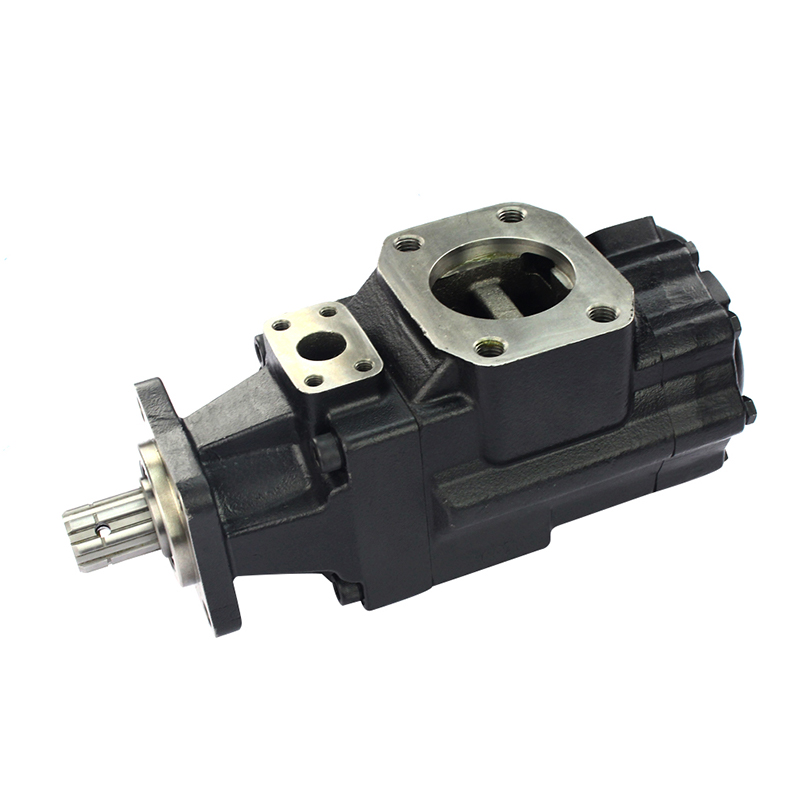
The shaft driving the pump is shown as a line entering the circle from the side opposite the flow triangle. When two pumps share a common shaft — a tandem pump configuration common in agricultural tractors and loader circuits — two circles are drawn connected by the same shaft line, each with its own flow triangle and outlet port.
Hydraulic Pump Symbol Variations by Pump Type
While the base symbol is the same for all hydraulic pumps, the combination of modifiers communicates the specific pump technology being used. The table below summarizes the most common pump types and their corresponding symbol characteristics:
| Pump Type | Displacement | Symbol Key Feature | Common Application |
|---|---|---|---|
| Gear pump (external) | Fixed | Circle + single outward triangle + single diagonal arrow | PTO systems, log splitters, low-pressure circuits |
| Vane pump | Fixed or variable | Circle + outward triangle; variable adds double diagonal arrow | Industrial presses, machine tools |
| Axial piston pump (fixed) | Fixed | Circle + outward triangle + single diagonal arrow | High-pressure mobile equipment |
| Axial piston pump (variable) | Variable | Circle + outward triangle + double diagonal arrow | Excavators, hydrostatic drives |
| Pressure-compensated piston pump | Variable | Circle + double arrow + spring + dashed pilot line | Energy-efficient industrial systems |
| Tandem pump | Fixed (each section) | Two circles on shared shaft line, each with outward triangle | Tractors, dual-circuit agricultural systems |
| Bidirectional pump | Fixed or variable | Circle + two opposing outward triangles on both ports | Hydrostatic transmissions, winches |
When reading a hydraulic schematic, the pump symbol is almost always connected to a prime mover symbol (electric motor or internal combustion engine) on one side and to the system pressure line on the other. The tank (reservoir) return line connects elsewhere in the circuit. Tracing these connections from the pump symbol outward is the starting point for understanding any hydraulic circuit diagram.
How PTO Powered Hydraulic Pumps Work
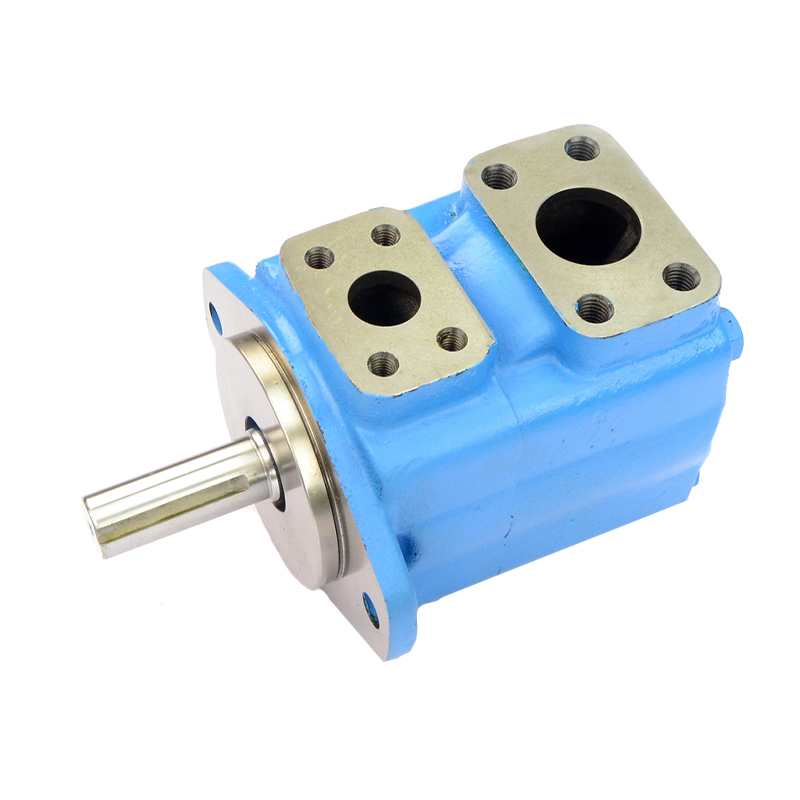
A PTO (Power Take-Off) powered hydraulic pump draws mechanical energy directly from a vehicle or tractor's transmission or engine, converting it into hydraulic flow and pressure to drive external work functions. The PTO shaft — standardized at 540 RPM or 1,000 RPM for agricultural tractors under ISO 500 and ASAE S203 standards — couples directly to the pump's input shaft through a splined connection or gearbox adapter.
Unlike electrically driven hydraulic power units or engine-mounted pumps with direct belt or gear drives, a PTO pump has a key operational characteristic: it only produces hydraulic flow when the PTO is engaged and the engine is running above idle. Flow output scales directly with PTO shaft speed — if the engine throttle drops, so does pump output flow and therefore the speed of any hydraulically driven actuators.
The hydraulic pump symbol used in a PTO-driven system schematic shows the standard pump circle with a shaft line, but the prime mover connected to that shaft is typically shown as an engine symbol or labeled "PTO" rather than the standard electric motor circle. In some schematics, a gearbox symbol appears between the PTO shaft and the pump to indicate a speed-increasing or speed-reducing drive ratio.
PTO Pump Types and Which Applications They Suit
The three main pump technologies used in PTO applications each offer different trade-offs in pressure capability, flow consistency, efficiency, and cost:
Gear Pumps (Most Common for PTO Use)
External gear pumps dominate PTO hydraulic applications because of their simplicity, robustness, and tolerance for contaminated fluid — important in agricultural and construction environments. A typical PTO gear pump operates at 150–250 bar (2,175–3,625 PSI) continuous pressure with flow rates from 11 to 114 liters per minute at 540 or 1,000 RPM PTO speeds. They are fixed displacement — flow is directly proportional to shaft speed and cannot be adjusted independently.
Piston Pumps (High Pressure, Variable Flow)
Axial piston pumps deliver higher continuous pressure — up to 350–420 bar (5,000–6,000 PSI) — and, in variable displacement configurations, allow flow to be adjusted independently of engine speed. This makes them suitable for demanding PTO applications such as truck-mounted cranes (knuckle booms), hook-lift systems, and high-pressure hydraulic tools. The trade-off is higher cost and greater sensitivity to fluid contamination — ISO 4406 cleanliness Class 16/14/11 or better is typically required.
Vane Pumps (Smooth Flow, Medium Pressure)
Vane pumps offer very smooth, low-pulsation flow that makes them suitable for PTO-driven applications where flow quality matters — certain conveyor systems, spray applications, and hydraulic steering assists. Pressure capability is moderate at 140–175 bar (2,000–2,500 PSI), and they are more sensitive to wear with contaminated fluid than gear pumps. Less common in agricultural PTO use but found in some industrial vehicle applications.
Key Specifications for Selecting a PTO Powered Hydraulic Pump
Matching a PTO hydraulic pump to its application requires evaluating several interdependent specifications. Getting any one wrong results in either undersized performance or premature pump failure:
| Specification | Typical Range | Selection Guidance |
|---|---|---|
| PTO Speed | 540 RPM or 1,000 RPM | Match pump input speed rating to tractor PTO output speed exactly |
| Displacement (cc/rev) | 11–100 cc/rev | Calculate: required flow (L/min) ÷ PTO speed (RPM) × 1,000 |
| Pressure Rating (continuous) | 150–420 bar | Must exceed system relief valve setting by at least 10–15% |
| Shaft Type and Spline | SAE A, B, C; 6 or 21-tooth spline | Must match PTO adapter or gearbox output exactly |
| Port Size and Standard | SAE, BSP, or ORFS | Match existing system hose and fitting standards to avoid adapter leaks |
| Rotation Direction | CW or CCW (viewed from shaft end) | Must match PTO shaft rotation — wrong direction destroys pump within minutes |
| Input Power Required (kW) | 5–75 kW | Must be within tractor's rated PTO horsepower capacity |
The rotation direction specification deserves particular emphasis. Running a gear pump in the wrong rotation direction immediately forces fluid against internal seals in the incorrect direction, causing catastrophic seal failure and pump destruction within minutes — not hours. Always verify rotation direction on the pump nameplate and compare against the actual PTO shaft rotation before startup.
PTO Pump Mounting Configurations and Drive Arrangements
PTO hydraulic pumps connect to the power source through several different physical arrangements depending on the vehicle type, available mounting points, and required pump location:
- Direct tractor rear PTO mount: The pump bolts directly to a bracket at the tractor's rear PTO stub shaft using a universal joint driveshaft. Common for powering external hydraulic implements — wood splitters, post drivers, hydraulic seeders. The pump and its reservoir are typically mounted on the implement frame, not the tractor.
- Transmission-mounted PTO (truck): On commercial trucks, a gearbox PTO port (SAE standard sizes A through F) accepts a matched PTO unit that drives the pump through a direct gear mesh. The pump is flange-mounted to the PTO gearbox. This is the standard arrangement for tipper trucks, refuse vehicles, hook-lift trucks, and crane trucks.
- Transfer case PTO: Four-wheel-drive trucks with transfer cases sometimes provide a PTO output from the transfer case, allowing pump operation while the vehicle is stationary with the drivetrain disconnected. Used in fire apparatus and emergency response vehicles.
- Engine flywheel PTO: Pumps mounted directly to the engine bell housing and driven off the flywheel through a clutch pack. Provides continuous pump operation independent of the gearbox — used in concrete mixers, snow blowers, and vacuum tankers where continuous hydraulic power is needed regardless of vehicle speed.
Calculating Required PTO Pump Displacement and Power
Properly sizing a PTO pump starts with defining the required hydraulic flow and pressure, then working back to displacement and input power requirements. The calculations are straightforward:
Required pump displacement (cc/rev):
Displacement = (Required flow in L/min × 1,000) ÷ PTO speed in RPM
Example: A log splitter requires 30 L/min at 1,000 RPM PTO speed. Displacement = (30 × 1,000) ÷ 1,000 = 30 cc/rev. Select a pump with displacement of 30–35 cc/rev to allow for volumetric efficiency losses (typically 5–15% in gear pumps).
Required input power (kW):
Power (kW) = (Flow in L/min × Pressure in bar) ÷ 600 ÷ overall efficiency
Example: 30 L/min at 200 bar, overall efficiency 0.85. Power = (30 × 200) ÷ 600 ÷ 0.85 = 11.8 kW (approximately 15.8 HP). The tractor's rated PTO output must exceed this figure — a 30 HP tractor PTO is adequate; a 20 HP tractor is not.
Always add a 20–25% safety margin above calculated power when specifying the tractor size, as pump efficiency decreases with wear and system pressure transients can exceed steady-state values during actuator stall conditions.
Common PTO Pump Problems and How to Diagnose Them
Most PTO hydraulic pump failures follow recognizable patterns that can be diagnosed before complete failure occurs:
- Cavitation (whining or screaming noise at startup): Caused by insufficient oil supply to the pump inlet — typically from a clogged suction strainer, collapsed suction hose, or reservoir fluid level too low. Cavitation erodes pump internals within hours of continuous operation. Check suction line vacuum with a vacuum gauge — more than 0.3 bar (9 inHg) at the pump inlet indicates a suction restriction.
- Low flow and slow actuator movement: In a gear pump, this indicates internal wear — the gear-to-housing clearance has increased beyond specification, allowing internal bypass. Compare actual flow output (measured with a flow meter) against the rated flow at operating speed. A reduction of more than 15% from rated flow in a gear pump indicates replacement is needed.
- Overheating hydraulic fluid: Causes include a pump operating at pressure continuously above its continuous rating, a system relief valve set too high, or insufficient reservoir volume. Hydraulic fluid temperature above 80°C (176°F) accelerates oil oxidation and seal degradation — a properly sized system should maintain fluid below 60–65°C under continuous duty.
- Shaft seal leakage: External oil leakage at the pump shaft indicates a failed shaft seal — usually caused by excessive case drain pressure (back pressure on the pump case drain port), contaminated fluid abrasion, or shaft misalignment. On gear pumps, case drain pressure should not exceed 3–5 bar (44–73 PSI) continuously.
- Erratic or pulsating flow: In gear pumps this indicates air ingestion through a leaking suction fitting or low fluid level causing the pump to draw air intermittently. Check all suction line fittings and the reservoir breather for blockage.